High-rise and condo windows in Chicago, and why a unit owner rarely decides alone
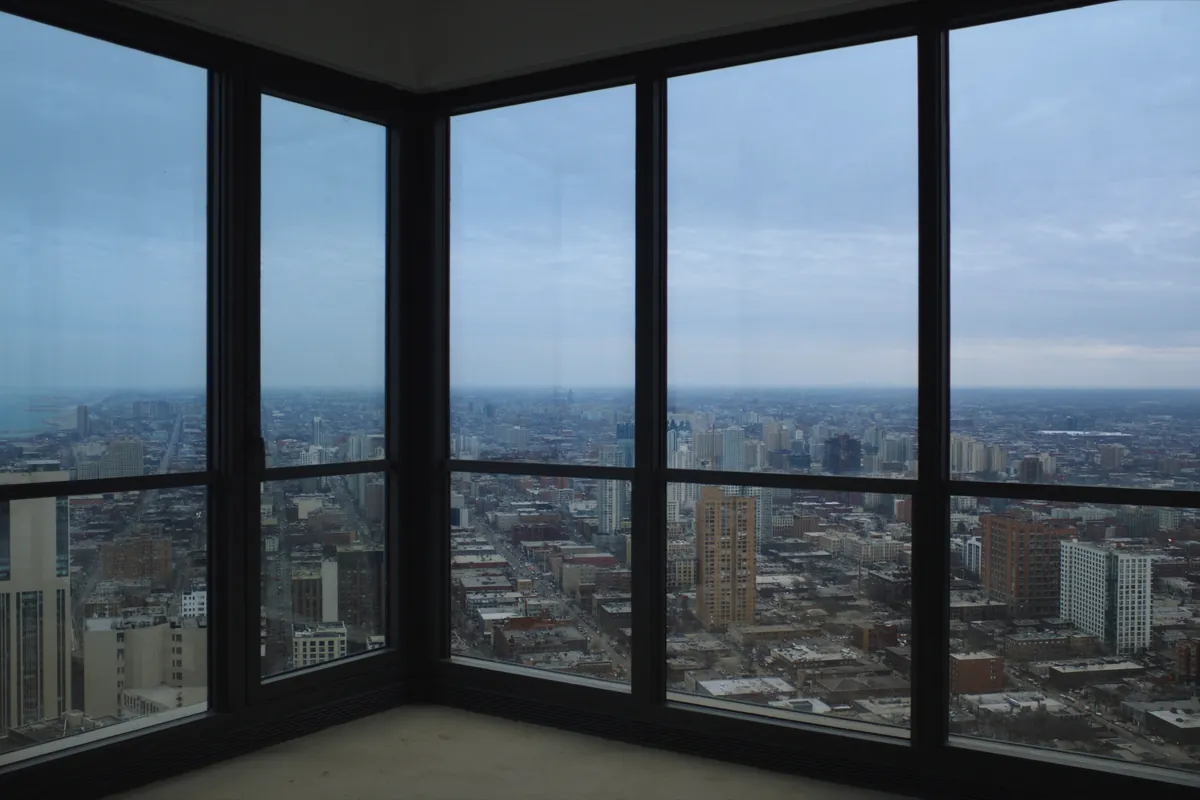
In a Chicago condo the first question is not which window to buy. It is whether the window is yours to buy. Under the Illinois Condominium Property Act the default treats all portions of windows in perimeter walls as part of the common elements, and separately deems a window serving one unit a limited common element assigned to that unit exclusively, with the board responsible for the common elements. Every word of that is subject to one opening clause: "Except to the extent otherwise provided by the declaration or other condominium instruments." Your declaration decides, not the statute. Height then decides the permit route. Chicago's no-permit exemption for an in-kind swap in an existing opening is written for a residential building up to four stories, and the Express Permit Program covers replacement up to seven stories, or taller only with drawings from an Illinois-licensed architect or structural engineer. On condominium property the city also requires an association approval letter.
Statute read in the full act as effective January 1, 2023, published by the Illinois Department of Financial and Professional Regulation, 2026-08-11. Permit wording quoted from chicago.gov, read 2026-08-11. This is a general description of a statute and not legal advice. This page sits under the Chicago housing stock hub.
Three questions, and they have to be answered in this order
Every other page in this pillar is about a building. This one is mostly about permission, because in a condominium the building is not the constraint and the paperwork is. Answer these in order and almost nothing on this page can surprise you. Answer them out of order and you can spend money on measurements for a job you were never entitled to commission.
| Order | Question | The document that answers it |
|---|---|---|
| First | Is the window mine to replace, and whose money pays for it? | Your declaration, read against the Illinois Condominium Property Act default |
| Second | Will the association approve this specific scope in writing? | The board's written position. Chicago asks for a condominium association approval letter on a condominium permit application |
| Third | Which permit route applies, and does it need a licensed design professional? | The city's no-permit lists and the Express Permit Program, both decided by how tall the building is |
Illinois Condominium Property Act and City of Chicago permit pages, both read 2026-08-11. The ordering is our recommendation, labeled as a recommendation rather than as statute or city text.
What the statute actually says about your window
The Illinois Condominium Property Act is readable, and the six provisions that decide a window question sit close together. The important habit is to read the qualifier before the rule, because the qualifier is doing most of the work.
- Everything below is optional. Section 4.1(a) opens "Except to the extent otherwise provided by the declaration or other condominium instruments". That single clause is why no website, including this one, can tell you who owns your window.
- Windows in perimeter walls are common elements by default. Section 4.1(a)(2) gives the unit the finished surfaces of a perimeter wall, "while all other portions of such walls, floors or ceilings and all portions of perimeter doors and all portions of windows in perimeter walls shall be deemed part of the common elements".
- And they are limited common elements. Section 4.1(a)(5) deems "Any shutters, awnings, window boxes, doorsteps, porches, balconies, patios, perimeter doors, windows in perimeter walls, and any other apparatus designed to serve a single unit" to be "a limited common element appertaining to that unit exclusively".
- A limited common element is still a common element. Section 2(e) defines common elements as all portions of the property except the units, "including limited common elements unless otherwise specified", and section 2(s) defines limited common elements as common elements "so designated in the declaration as being reserved for the use of a certain unit or units to the exclusion of other units".
- The board's default duty covers common elements. Section 18.4(a) makes the board responsible "To provide for the operation, care, upkeep, maintenance, replacement and improvement of the common elements".
- The declaration has to spell the assignment out. Section 4(g) requires the declaration to contain "A description of both the common and limited common elements, if any, indicating the manner of their assignment to a unit or units".
Illinois Condominium Property Act, 765 ILCS 605, full text as effective January 1, 2023, published by the Illinois Department of Financial and Professional Regulation, read 2026-08-11. A general description of a statute, not legal advice. If your declaration is ambiguous, that is a question for a lawyer rather than for a salesperson.
Why both answers you have heard are half right
Ask around a Chicago condo building and you will hear two confident and opposite answers: the window is yours, and the window is the building's. The statute explains why both survive. A window in a perimeter wall is, by default, part of the common elements and reserved for the exclusive use of one unit. Exclusive use is not ownership, and a shared element that only you can use still sits inside the board's default maintenance duty. Then the declaration arrives and may reassign the cost, the decision, or both.
That is why the useful question is never "is it mine". It is three narrower ones, and they can have different answers in the same building: who pays, who decides the specification, and who is allowed to hire the contractor. Ask them separately and get the answers in writing.
The declaration is the document, so get it before you get quotes
Section 4(g) requires your declaration to describe the common and limited common elements and how they are assigned, so the answer exists in a document you are entitled to read. Most owners have never opened it, and most sales visits proceed as though it does not exist.
- Find the window language, not the general language. Look for the schedule of limited common elements and any clause on maintenance, repair and replacement. The words that matter are which party bears the cost and which party controls the specification.
- Check whether the declaration overrides the statutory default at all. It may be silent, in which case the default in section 4.1(a) applies. Silence is an answer, and it is a different answer from an express reassignment.
- Ask for the board's written position on your specific scope. Not "can I replace my windows", but the exact unit type, frame material, color, grille pattern, glass and operation. A general permission is not an approval of the thing you are about to buy.
- Ask whether a building-wide program already exists. If the association intends to replace windows on a schedule, paying privately now can mean paying twice, once yourself and once through assessments. This is our reading of how the default duty and a capital program interact, not statutory text.
- Keep it all in writing. The contractor is not the party who can settle any of this, and a verbal approval from a board member is not a board position.
Height decides the permit route, and it decides it twice
Chicago draws two separate lines through this, at four stories and at seven, and they do different jobs. The four-story line decides whether you need a permit at all. The seven-story line decides whether the streamlined route needs a licensed design professional.
The city publishes two lists of work that does not require a building permit. One applies in any building. The broader one applies only "in a residential building up to 4 stories above grade or an associated accessory building (such as a garage) on the same lot", and it is the one that carries "Repairing or replacing (in-kind) an exterior window or skylight in the existing opening". In-kind is defined by the city as "replacement of existing materials, objects, or elements using new materials, objects, or elements of the same type, size, and shape".
| Situation | Position under the city's published lists |
|---|---|
| Repairing damage to an existing window, or replacing glass in an existing sash | No building permit, in any building, at any height |
| Installing, maintaining or removing a storm window or an insect screen | No building permit, in any building, at any height |
| Ground-level unit, in-kind replacement including the frame | No building permit in any building, "provided that the work does not require cutting away or removal of any portion of an exterior wall" |
| Unit above the ground floor in a building of five stories or more, in-kind swap | Not on the exemption list. The broader exemption stops at four stories, so the permit route applies |
| Any building up to seven stories, replacement in an existing opening | Eligible for the Express Permit Program |
| Building taller than seven stories, replacement in an existing opening | Eligible for the same program only "With drawings prepared by an Illinois-licensed architect or structural engineer" |
| Designated or proposed Chicago Landmark, or a landmark district, any height | Unsettled. The city says its exceptions "may not apply" and does not enumerate which survive |
City of Chicago, Guide to Building Permits, work not requiring a building permit, exterior worktype, and the Express Permit Program instructions for exterior window or door replacement, both read 2026-08-11. The right-hand column applies the city's published lists to condominium situations. The full rule, quoted in both lists, is on do I need a permit, and the program is walked step by step on the Express Permit Program page.
The ground-floor split inside one building
Read those first three rows together and something odd falls out. In a 30-story building, the ground-floor unit replacing a window in kind, without cutting away any part of the exterior wall, is on the city's no-permit list. The unit on the second floor doing the identical work is not, because the exemption that reaches upper floors is written for a residential building up to four stories. Same building, same window, different answer. If a neighbor tells you they did theirs without a permit, that is the first thing to check before you copy them.
The seven-story line is a schedule item, not a formality
Above seven stories the Express Permit Program still applies, but only with drawings prepared by an Illinois-licensed architect or structural engineer. That is a person who has to be engaged, briefed and paid before the application exists, and it is the single largest difference between a high-rise window job and every other building type on this site.
We publish no figure for what those drawings cost, because none was read at a primary source, and a number nobody can check is worse than no number. What you can do is make the question explicit in every quote: who prepares the drawings, who stamps them, and is that inside the price or outside it. A quote that is silent on all three is not comparable with one that includes them. The same discipline runs through what is actually in a quote.
What disqualifies a high-rise from the express route
The city publishes a not-eligible list, and three of its five items are ordinary features of Chicago multi-unit buildings rather than edge cases. Check your own elevation against them before anyone promises you a streamlined permit.
| Not eligible, in the city's words | Why it turns up in a condo building |
|---|---|
| "Creating a new opening in an exterior wall or roof for a new window, door, or skylight" | Rare in a unit, but this is also what a scope quietly becomes if anyone proposes to change an opening size |
| "Replacing a window or door that has or is required to have fire-rated glass" | Fire-rated assemblies are ordinary in multi-unit construction. Whether a given opening is required to have it is a question for the design professional, not the salesperson |
| "Replacing a window or door within 10 feet of a fire escape" | Exterior fire escapes are common on older Chicago multi-unit buildings, and the measurement is from the opening, not from the unit |
| "In a building with more than 3 stories, replacing a window in a wall that is within 2 feet of a lot line that separates two properties" | Chicago buildings sit tight to their lot lines. This one is written specifically for buildings above three stories, so it lands on exactly the buildings this page covers |
| "Installing a new window, door, or skylight that does not meet minimum energy efficiency requirements of the Chicago Energy Transformation Code" | A product question, and the one item on this list you control by what you specify |
City of Chicago, Express Permit Program, exterior window or door replacement, read 2026-08-11. The right-hand column is our reading of the sourced list applied to condominium buildings, labeled as a reading. Energy requirements are covered on the energy code page.
What every express application requires, and the one extra for condos
The program has a fixed set of requirements. Every applicant needs a licensed general contractor, with the contractor class from A to E set by project cost, and every application needs at least one existing-condition photograph and an energy and water efficiency compliance form uploaded. Condominium property carries one more requirement, and it is the sentence that makes this whole page necessary: the city asks for a condominium association approval letter.
Read that as leverage rather than as an obstacle. It means the association's position is not a matter of etiquette between neighbors, it is an item the city expects to see on the application. It also means a contractor who tells you the board does not need to be involved is describing a permit application they cannot complete.
City of Chicago, Express Permit Program, exterior window or door replacement, read 2026-08-11. The program launched on November 6, 2023 and replaced the Easy Permit Process, so a contractor still using the older name is working from older information.
Terms that constrain what you are allowed to buy
The program's terms and conditions limit the product, not just the paperwork. Four of them change what a high-rise unit can specify.
- Existing openings only. The permit "only authorizes installation of replacement skylights, windows, and doors in existing openings", does not authorize creating any new opening, and "does not authorize any increase or decrease in the size of existing wall or roof openings".
- No loss of glass area. A replacement "must have an equal or greater area of transparent or translucent glazing as the window or skylight it replaces". Thicker modern frames inside a fixed opening are exactly how glass area gets lost, so ask for the visible glass dimensions and not only the unit dimensions.
- No loss of openable area. In a residential building a replacement "may not have less openable area than the widows it replaces". That is the city's own typo, quoted as printed.
- Opening control devices where sills are low. A replacement window "must include opening control devices that limit the opening to less than 4 inches within 42 inches above the floor when the windowsill is less than 36 inches above the floor". Low sills are common in apartment and condominium construction, so this is a live requirement here rather than a rarity.
City of Chicago, Express Permit Program terms and conditions for window and door replacement, read 2026-08-11.
Landmark high-rises are real, and the review is not the delay people expect
Chicago has designated landmark buildings and districts that are exactly this housing type. Both "860-880 Lake Shore Drive" and the "East Lake Shore Drive District" appear on the city's own Chicago Landmarks listings. That page states it shows just a portion of the designations, so treat it as evidence that landmark high-rises exist rather than as a complete list.
If your building is designated, the Commission on Chicago Landmarks reviews the permit application. The city is direct about what that adds and what it does not: "No additional City permits are required for Landmark buildings. The Commission simply reviews permits as part of the normal building permit process. The Commission annually reviews some 2,000 permits for Landmark properties, most of which are approved in one day." The Department of Buildings routes applications to Commission staff as part of the ordinary process.
What is protected is usually the outside of the building as the public sees it. The Commission states that "For most landmark districts, the significant features typically are the exterior building elevations visible from the public right-of-way except regarding work involving demolition." On a tower, that puts the visible elevations squarely inside review.
Window work does not appear on the city's published list of project types taken to a public meeting, which covers new infill construction, garages on corner properties, additions and rooftop additions visible from the public way, certain signage, driveways and curb cuts, larger demolitions, and projects staff refer up. Our inference is that routine window work is handled at staff level, since the city also says projects not requiring the Commission's or its Permit Review Committee's review may be approved by staff through the regular building permit process. The city never states that in those words, so it is labeled as our inference rather than as a rule.
Commission on Chicago Landmarks, Questions and Answers 2025, and Permit Application Submission Requirements dated December 5, 2024, both read 2026-08-11. Chicago Landmarks listings read 2026-08-11. Full detail on how review works is on the landmark districts page.
What a landmark building has to submit for windows
The submission requirements are heavier than most owners expect, and in a condominium they are normally the association's job rather than yours. The baseline alterations checklist asks for information on existing conditions and on the proposed work: photographs, details, drawings, material samples, specifications, product literature, shop drawings and cut sheets. The windows addendum then asks for more.
"New Windows: Large-scale side-by-side drawings of the existing and proposed windows for each window type, including elevations, cross and longitudinal sections, and details, as necessary, all dimensioned and to scale. Sections including profiles of sashes, any mullions or muntins, meeting rails, sills, brick molds, and headers/lintels."
Two mitigations are published alongside it. "If the existing windows are modern replacements, drawings of the existing windows may not be required", which matters in a tower already re-glazed once. And manufacturer's product cut sheets "may be accepted in lieu of drawings of the proposed windows", depending on their scale, completeness and level of detail. Two warnings come with it: staff "may defer review of an application until the submittals are complete", and everything submitted is subject to disclosure under the Illinois Freedom of Information Act.
The city also encourages a pre-permit conversation, which costs nothing and is the cheapest risk reduction available on a designated building: "The Landmarks Commission encourages applicants to seek its advice and guidance before filing a permit application." For a first review, typically minimal information is required, such as photographs, a plat of survey and a description of the proposed work. The Historic Preservation Division is on 312.744.3200 and [email protected].
Permit Application Submission Requirements dated December 5, 2024, Pre-Permit Submission Requirements 2026, and the Historic Preservation Division permit review page, all read 2026-08-11.
The permit fee waiver, and the sequencing rule that decides it
The city operates a Permit Fee Waiver for designated Chicago Landmark property. It may be available for individually landmarked buildings and for buildings in landmark districts, and it covers only fees for permits for which Commission approval is required. Barricade, canopy and water tap permits and fees are not eligible. We publish no enactment date for it, because no such date was read at a primary source in this pass.
The part that costs people the waiver is the order of operations. The city's own form states that permit fee waiver applications are not accepted after the permit has been issued, and the waiver has to travel through City Council as an ordinance: introduced at one meeting, referred to committee, then passed at a later meeting and published before it is valid. Four documents are required with the application: the Permit Fee Waiver Form, personal profile information, an Economic Disclosure Statement and an Affidavit of Child Support Compliance.
We publish no amounts, timelines or application windows for it. Those change, and the agency owns them. If your building is designated, read the city's own form for current terms before anyone files a permit application, because afterwards is too late.
City of Chicago, Permit Fee Waiver form (2020), read 2026-08-11: the form and its instructions. Honest gap: the waiver covers permits for which Commission approval is required, and the Commission reviews all landmark permit applications, but the two documents do not join up on whether a routine window permit qualifies. We could not resolve it and do not guess.
You may not need new windows at all
- The job may not be yours to buy. If the declaration leaves the statutory default in place, the window is a common element reserved for your exclusive use, and the board's default duty under section 18.4(a) covers replacement of common elements. Paying privately for something the association is responsible for is a decision to make knowingly, not by accident.
- A building-wide program changes the maths. If a capital plan already exists, a private replacement now can mean paying twice, once directly and once through assessments. Ask the board what is scheduled before you ask a contractor what it costs. This is our reading rather than statutory text.
- One failed unit is a repair. Repairing damage to an existing window and replacing glass in an existing sash need no building permit in any building at any height. A failed seal in one opening is not an argument for replacing 14 of them.
- Storm windows need no permit anywhere in Chicago. Installing, maintaining or removing a storm window or an insect screen is on the no-permit list for any building at any height. See storm windows.
- In a landmark building, the city itself argues for repair. The Guidelines adopted March 4, 1992 open with it: "The first and best answer to the question of how to treat windows is not to replace them but rather to retain and repair the existing sash and frames." They add that properly weather-stripped single-glazed sash "can greatly reduce or eliminate air infiltration between sash and frame where most energy is lost", at a cost the city calls nominal against the price of replacement windows. If total replacement is unavoidable, the replacement "must match the historic windows in design and operation, material, glass size, muntin arrangements, profiles, and trim such as brick mold and sill".
- Price both paths before choosing one. Ask for a repair price alongside the replacement price. The economics are worked through on repair or replace.
Illinois Condominium Property Act, the city's no-permit list and the 1992 Guidelines, all read 2026-08-11.
What we could not source, and will not guess
- What a condo or high-rise window job costs in Chicago. No price was read at a primary source for this pillar, so no dollar figure appears anywhere on this page, including for a stamped drawing set. Read the cost pillar, which attributes every figure it publishes and states plainly where it has none.
- Whether landmark property can use the Express Permit Program for windows. The word landmark appears zero times across the program's window instruction page, its terms and conditions page and its overview page. The city publishes nothing either way, so we assume nothing either way.
- Which no-permit exceptions survive landmark status. The city's only statement is that these exceptions "may not apply", and it does not enumerate. Its own instruction is to contact the Historic Preservation Division, which is what we tell you to do.
- Whether the fee waiver reaches a routine window permit. Recorded above as an open question rather than resolved in either direction.
- What share of Chicago housing sits in high-rise or larger multi-unit buildings. Census units-in-structure data would size it. The Census interface now requires a key and returned a missing-key error on every call, so this page claims no share.
- How many Chicago Landmark districts and individual landmarks exist today. The city's open data answers, but its landmark districts dataset reports a last-updated date in 2011 and its most recent designation is from 2009. A stale count published as a current one is worse than no count at all.
The order to do things in, and what to ask
Each step is cheap and can make the next one unnecessary, which is the opposite of how a condo window project usually runs.
- Read the declaration and find the limited common element schedule and the maintenance and replacement clauses.
- Get the board's written position on your exact scope, and ask whether a building-wide program is planned.
- Settle designation with one call to the Historic Preservation Division, 312.744.3200, before anything is ordered.
- Fix the permit route by building height: no permit, express permit, or express permit with stamped drawings above seven stories.
- Write one scope, in the city's own words: same opening, same type, same size, same shape, and hand it to every contractor.
- Only then collect quotes, and compare them against that one scope rather than against each other.
Four questions worth asking out loud before signing anything:
- Who prepares and stamps the drawings if this building is taller than seven stories, and is that inside your price?
- Who is obtaining the condominium association approval letter the city asks for, you or me?
- Does this price change the size or shape of any existing opening, in any dimension?
- What are the visible glass dimensions and the openable area of the proposed units, against the existing ones?
Where to go next
- The Chicago housing stock hub, for the building types side by side.
- Two-flat and three-flat windows, the other multi-unit case, where the four-story line falls the other way.
- Chicago bungalow windows, for how the same in-kind test reads on a single-family building.
- The Express Permit Program, step by step, including the uploads.
- Landmark and historic district window rules, for what the Commission reviews and what gets submitted.
Sources
All read 2026-08-11. Illinois: Condominium Property Act, 765 ILCS 605, full text as effective January 1, 2023, published by the Illinois Department of Financial and Professional Regulation. City of Chicago: work not requiring a building permit, exterior, Express Permit Program, window and door replacement, its terms and conditions, the program overview, Permit Application Submission Requirements, dated December 5, 2024, Commission on Chicago Landmarks Questions and Answers 2025, the Guidelines for Alterations to Historic Buildings and New Construction, adopted March 4, 1992, the Historic Preservation Division permit review page, Pre-Permit Submission Requirements 2026, the Permit Fee Waiver form, the Chicago Landmarks listings, and the Chicago Landmark Address List, August 2026. No competitor page, contractor blog, retailer page, forum or search-engine summary informed any statement above.
If you want quotes to hold against the answers on this page, the form below is the place to start, free and with no obligation. What this site does, and does not do, is set out on the about page.
Cost and next step
What it costs, and what happens after you send the form
- What does window replacement cost in Chicago?
- The best-attributed Chicago-area figure we found puts it at $650 to $1,200 per window installed for a standard vinyl double-hung, and $6,000 to $16,000 for a 10 to 15 window whole-home job in Illinois. That is one publisher's read of a market, not a price list, and no agency publishes what window work costs. Source: Modernize, "Window Replacement Cost and Pricing in Illinois (2026)", Isabella Andersen, reviewed by Catie Bonner, updated March 18, 2026, read 2026-08-11. The cost section shows the full range, the sources that disagree, and why we do not average them.
- What happens after you send the form?
- Your request goes to an independent licensed local window contractor, usually within about an hour during the day. That contractor then contacts you to look at the windows and quote the work on their own schedule.
- What does this site help with?
- The guides here cover window types, materials, cost, permits, Chicago home styles, and hiring a contractor.
Free, and no obligation
Get free quotes on your Chicago windows
A marketing service, not a licensed contractor. Window work is performed by independent licensed local contractors.
Straight answers
Questions Chicago homeowners ask
- Who owns the window in a Chicago condo, me or the association?
- Your declaration answers it. The statute only sets a default, and it says so in its own first words. Section 4.1(a) of the Illinois Condominium Property Act opens "Except to the extent otherwise provided by the declaration or other condominium instruments". Subject to that, section 4.1(a)(2) gives the unit the finished surfaces of a perimeter wall "while all other portions of such walls, floors or ceilings and all portions of perimeter doors and all portions of windows in perimeter walls shall be deemed part of the common elements", and section 4.1(a)(5) deems windows in perimeter walls "a limited common element appertaining to that unit exclusively". Section 18.4(a) makes the board responsible "To provide for the operation, care, upkeep, maintenance, replacement and improvement of the common elements". So the default is not simple private ownership, and many declarations then move the cost to the unit owner, which is lawful and common. This is a general description of a statute and not legal advice. Full act as effective January 1, 2023, published by the Illinois Department of Financial and Professional Regulation, read 2026-08-11.
- Can I replace my unit's windows without the association agreeing?
- Chicago's own paperwork makes that difficult, whatever your declaration says. Where a window replacement needs a permit, the city's Express Permit Program lists a "Condominium association approval letter" among the requirements for condominium property, alongside the requirements every applicant has: a licensed general contractor, at least one existing-condition photograph, and an energy and water efficiency compliance form. That is the city asking for the association's position in writing before it issues the permit. Separately, the statute treats a window in a perimeter wall as a limited common element and gives the board the default duty over common elements. The practical order is: read the declaration, get the board's written position, then price the job. Read at chicago.gov, 2026-08-11.
- Do I need a building permit to replace windows in a Chicago high-rise?
- Above the ground floor, assume yes. Chicago publishes two separate lists of work needing no building permit. The broader one, covering an in-kind replacement in an existing opening at any floor, is written only for "a residential building up to 4 stories above grade or an associated accessory building (such as a garage) on the same lot". A high-rise is outside it. The shorter list applies in any building and covers repairing damage to an existing window, replacing glass in an existing sash or door frame, installing, maintaining or removing a storm window or an insect screen, and "Replacing (in-kind) an existing ground-level window, including the frame, provided that the work does not require cutting away or removal of any portion of an exterior wall". So a ground-floor unit and the unit above it can be in genuinely different positions in the same building. Read at chicago.gov, 2026-08-11.
- My building is taller than seven stories. What changes?
- You need a licensed design professional before you have a permit application. The Express Permit Program covers "Replacing a window in an existing wall opening in a building up to 7 stories tall". Above that height the same program is still open, but only "With drawings prepared by an Illinois-licensed architect or structural engineer". That is a real cost and schedule item that does not exist on a bungalow job, and it lands before any glass is ordered. We publish no figure for what those drawings cost, because none was read at a primary source. Ask whoever is quoting the job who is preparing and stamping the drawings, and whether that is inside their price. Read at chicago.gov, 2026-08-11.
- What is not eligible for the express permit route?
- Five things, and three of them are far more likely in a tall building than in a house. The city lists as not eligible: creating a new opening in an exterior wall or roof; "Replacing a window or door that has or is required to have fire-rated glass"; "Replacing a window or door within 10 feet of a fire escape"; "In a building with more than 3 stories, replacing a window in a wall that is within 2 feet of a lot line that separates two properties"; and installing a window, door or skylight that does not meet the minimum energy efficiency requirements of the Chicago Energy Transformation Code. Fire-rated glass, fire escapes and lot-line walls are ordinary features of Chicago multi-unit buildings, so check all three against your own elevation before anyone promises a streamlined route. Read at chicago.gov, 2026-08-11.
- My condo building is a Chicago Landmark. Does that change the process?
- It adds a reviewer, not a second permit. The Commission on Chicago Landmarks states that "No additional City permits are required for Landmark buildings. The Commission simply reviews permits as part of the normal building permit process." The Department of Buildings routes applications to Commission staff, and the Commission "annually reviews some 2,000 permits for Landmark properties, most of which are approved in one day". What does change is what you submit: the alterations checklist plus a windows addendum asking for "Large-scale side-by-side drawings of the existing and proposed windows for each window type", with sections and profiles. Landmark high-rises are real in Chicago, and both "860-880 Lake Shore Drive" and the "East Lake Shore Drive District" appear on the city's own landmark listings. Read at chicago.gov, 2026-08-11.
- What does a high-rise window replacement cost in Chicago?
- No figure appears on this page, and that is deliberate. This site publishes a price only with the source it came from and the date it was read, and no Chicago condominium or high-rise window price was read at a primary source. The honest reason is also structural: a unit in a building of eight stories or more may carry stamped drawings from an Illinois-licensed architect or structural engineer, a board approval process, access equipment, and a scope set by a declaration rather than by you. Those variables move a price further than the glass does. Read the cost pillar, which attributes every figure it publishes and says plainly where it has none, then make every contractor price one identical written scope.
Before you sign anything
Get quotes you can actually compare
Tell us how many openings you have and where in Chicago you are. Quotes come back free and with no obligation, priced on your actual openings rather than on a published range.
Get quotes